
Repairs · Updated 30 September 2026 · 5 min read
Ridge Capping Explained: Re-Bedding, Re-Pointing and Why Mortar Cracks
What ridge capping does, the difference between re-bedding and re-pointing, why ridge mortar cracks within 8 to 15 years, and what the work costs.
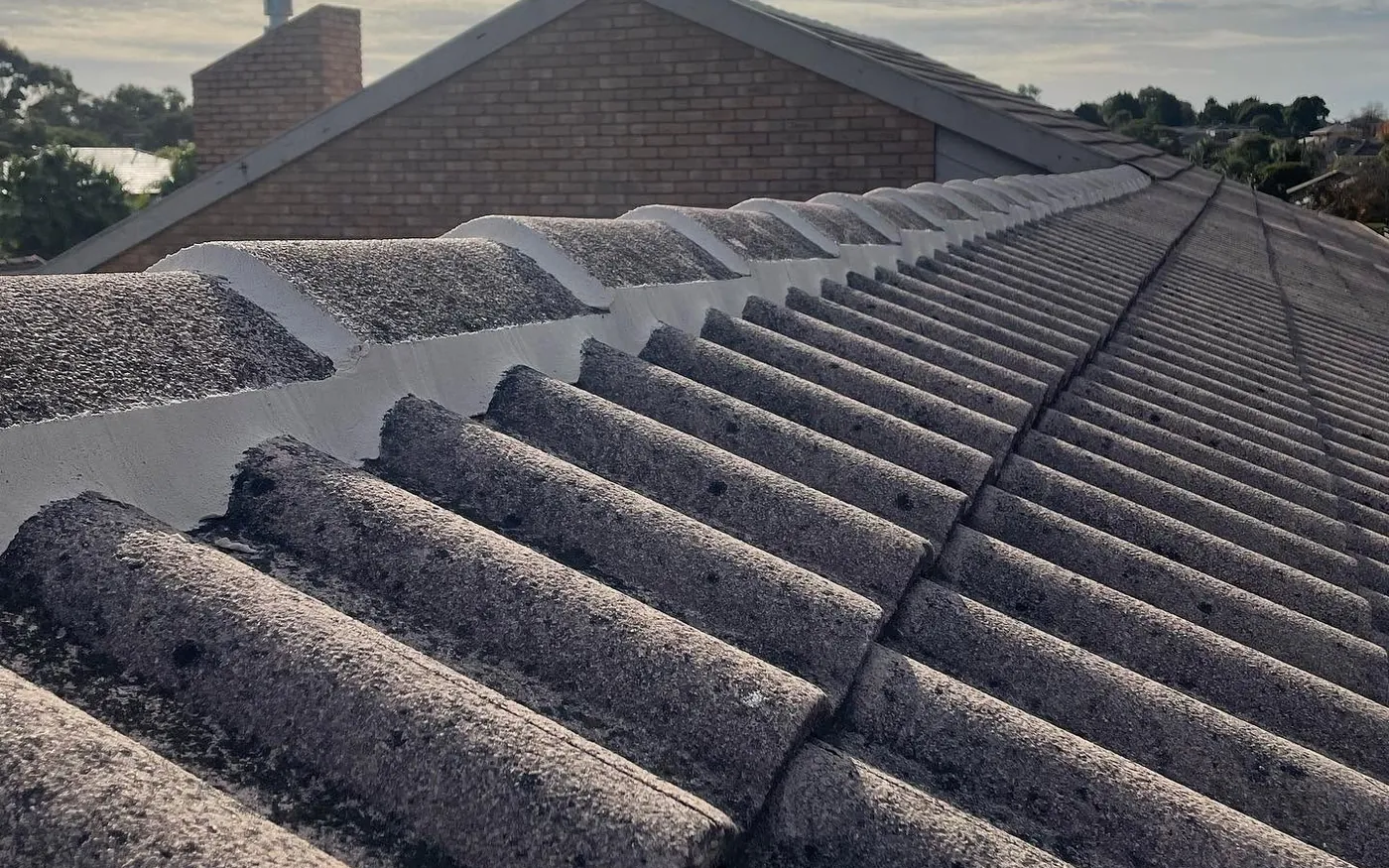
- Ridge caps sit on a mortar bed with a thin pointing layer over the top. Both fail with age.
- Re-pointing replaces the outer layer; re-bedding lifts the caps and replaces the mortar underneath.
- Mortar is rigid and the roof moves, so cracking within 8 to 15 years is normal.
- Published guides put ridge repair at $390 to $1,175 and full re-bedding at $40 to $80 per metre.
What ridge capping does
Where two roof faces meet at the top, there is a gap. Ridge caps are the curved or angled tiles that cover it along the main ridge and down every hip. They keep rain and wind out of the roof cavity and hold the top course of tiles in place. On a tiled roof they are the only tiles that are not hooked over a batten, which is why they need mortar.
The caps sit on a bed of sand and cement mortar that fills the space between the cap and the tiles below and fixes it in position. Over the bed goes a thin finishing layer, the pointing, that seals the edge and gives the neat line you see from the street. Modern work uses a flexible pointing compound for that outer layer rather than more mortar.
There is more ridge on a house than most people think. A typical single-storey home carries 8 to 14 lineal metres of main ridge plus 4 to 8 metres of hip, and a hipped roof with several gables carries more. Every metre of it depends on mortar that was never designed to last as long as the tiles. This is the work covered on our ridge capping and re-pointing page.
Why the mortar cracks
Mortar is rigid. The roof under it is not. Tiles expand in the sun and shrink at night, timber battens and rafters move with moisture, and wind loads push and lift the whole structure. Something has to give, and it is the mortar. Ridge mortar is expected to crack within 8 to 15 years, so on a roof that has never been touched the pointing is usually gone well before the tiles show any wear.
The Sunshine Coast is hard on it. The Bureau of Meteorology records a mean maximum of 29.1 degrees in January and 1,492.6 mm of rain a year at the airport, so ridges go through big heat swings and heavy soakings. The coast sits in AS/NZS 1170.2 wind Region B, with design winds of 162 to 198 km/h, and a local wind hazard study found gusts around 5 m/s above that. Loose caps are the first things a gust lifts.
Once the pointing cracks, water gets into the bed. The bed softens and crumbles, the cap moves more, and the crack widens. Near the surf, salt speeds that up. Left long enough, caps slide or blow off and the roof cavity is open to the weather.
Re-pointing versus re-bedding
Re-pointing is the lighter job. The old pointing is ground or chipped out, the bed is checked and cleaned, and a flexible pointing compound is applied over the sound bed. Flexible pointing moves with the roof instead of cracking against it, which is why it has replaced mortar as the finishing layer. Re-pointing suits a roof where the caps are tight and the bed is still solid.
Re-bedding is the full job. The caps are lifted off, the old mortar bed is removed, a new bed is laid and the caps are set back in line. Then it is pointed as above. Re-bedding is needed when the bed has crumbled, when caps rock or sit out of line, or when they have moved enough that pointing alone would not hold them.
How do you tell which one you need? From the ground, cracked or missing pointing with the caps still straight usually means re-pointing. Caps that look uneven, gaps you can see under them, or chunks of mortar on the ground or in the gutter point to re-bedding. We check by tapping and pushing each cap on the inspection. Both are done to AS 2050:2018, the roof tile installation standard that covers bedding and pointing.
What the work costs
Ridge work is priced by the job for small repairs and by the metre for a full re-bed. The whatsthedamage Sunshine Coast guide lists a ridge capping repair at $390 low, $730 typical and $1,175 high. For full re-bedding and re-pointing, Rite Price Roofing quotes $40 to $80 per metre, with a typical house at $1,500 to $4,500. ABC Roof Restoration in Brisbane starts at $85 per metre.
| Ridge work | Guide range |
|---|---|
| Ridge capping repair (small job) | $390 to $1,175, typical $730 |
| Re-bed and re-point, per metre | $40 to $80 |
| Re-bed and re-point, typical house | $1,500 to $4,500 |
Those are guide figures from published sources, not our prices. Length, pitch, access and whether edge protection is needed all move the number. Within a full roof restoration the ridge work is part of the package, which is usually the better value if the coating is also due. Our cost guide has the rest of the numbers.
Signs it is time
You do not need to get on the roof to spot most of these. Look from the footpath or from an upstairs window at a neighbour’s place.
- Cracks along the pointing line. Fine cracks first, then gaps.
- Missing chunks. Pointing that has fallen away, leaving bare mortar or a gap under the cap.
- Mortar in the gutters. Grey lumps or sand in the gutter or on the ground below a hip.
- Caps out of line. A wavy ridge line where caps have moved.
- Moss along the ridge. Growth in the cracks means water is sitting in them.
- Ceiling stains near the ridge or along a hip. Water is getting past the caps.
Any of these before storm season is a reason to act. Cracked ridges are one of the most common causes of storm-time leaks, and a lifted cap in a gust can take tiles with it. Our storm season checklist puts ridges at the top of the list. If water is already coming in, see roof leak repairs.
Ridge work across the Sunshine Coast
Older tile roofs need this most. Brick-and-tile homes from the first waves of development in Golden Beach, Currimundi and Buddina have often been through the mortar cycle more than once. Newer estates such as Baringa and Peregian Springs are coming up to their first round now. Hinterland homes in Montville see more rain and more moss along the ridge.
Seaspray Restos does ridge work as a standalone job or as part of a full restoration. Either way, the process is the same: inspect and tap every cap, re-bed where the bed has gone, re-point everything with flexible compound, and check the tiles either side of the ridge while we are there. Small roof repairs such as replacing cracked tiles are done in the same visit.
All work is done by a QBCC licensed contractor (lic. 15424815) and carries our 10-year warranty (terms apply). To get started, contact us and we will begin with a satellite look at your roof and follow up with an inspection.
Sources
- Roofing Calculator HQ ridge cap cost calculator
- Bureau of Meteorology, Sunshine Coast Airport climate averages
- Greenline on AS/NZS 1170.2 wind regions
- Sunshine Coast wind hazard study
- AS 2050:2018 Installation of roof tiles
- whatsthedamage roofing cost guide, Sunshine Coast
- Rite Price Roofing re-bedding and re-pointing cost
- ABC Roof Restoration cost guide

Questions
Ridge capping questions
What is the difference between re-bedding and re-pointing?
Re-pointing replaces only the outer finishing layer with a flexible pointing compound, over a bed that is still sound. Re-bedding lifts the ridge caps, removes the old mortar bed, lays a new one and resets the caps before pointing. Re-bedding is needed when the bed has crumbled or the caps have moved.
How often does ridge capping need to be redone?
Ridge mortar is expected to crack within 8 to 15 years, so most tiled roofs go through it at least twice in their life. Flexible pointing over a sound bed lasts longer than old mortar pointing because it moves with the roof. Heat, storms and salt on the Sunshine Coast tend to push roofs toward the earlier end.
How much does ridge capping repair cost on the Sunshine Coast?
Published guides list a ridge capping repair at $390 to $1,175, with $730 typical, for a small job. Full re-bedding and re-pointing runs $40 to $80 per metre, or $1,500 to $4,500 for a typical house. These are guide figures. We quote from satellite imagery first and confirm on site.
Can cracked ridge capping cause a leak?
Yes. Once the pointing cracks, water runs into the bed, softens it, and then finds its way under the caps into the roof cavity. Leaks along a hip or near the main ridge are one of the most common we see. Re-pointing or re-bedding stops it, and it is far cheaper than repairing a wet ceiling.
Free quote
Need a hand with your roof?
Send your address for a satellite estimate, or call Tyler.
0434 142 995- Satellite estimate within a business day
- 10-year warranty (terms apply)
- QBCC licensed, home warranty covered
- Australian-made coatings